Tartan Vitalis
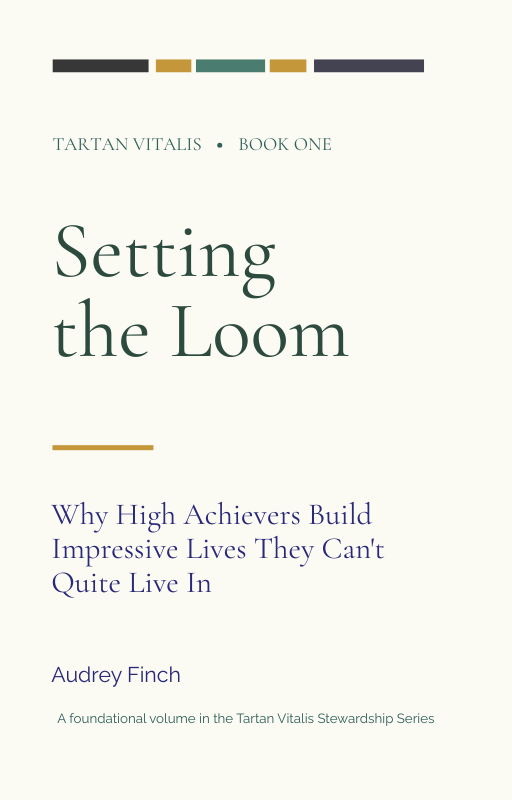
TARTAN VITALIS BOOK ONE
Setting
the Loom
Why High Achievers Build Impressive Lives They Can't Quite Live In
You have built an impressive life. The career, the reputation, the visible markers of success. And yet something doesn't fit.
Decisions made under pressure you can't later defend. Commitments you never quite chose. The persistent, private sense that your life is held together with string.
This is not a motivation problem. It is a structural one. And structural problems have structural solutions.
By Audrey Finch
"This is not a productivity book. It is not a habits book. It is a book about the conditions that allow a life to hold — and what it looks like when those conditions have quietly stopped being met."
SETTING THE LOOM
ABOUT THE BOOK
The foundations were never
the problem you were told about
Most instability in high-achieving lives doesn't come from failure. It comes from building — faster, further, higher — on foundations that were never stable enough to hold the weight being placed on them.
The skills that build an impressive career are not the same skills that build a coherent life. One set optimises for external outcomes. The other requires examining foundations most high achievers have never touched.
Setting the Loom is the book that names the structural conditions a life needs to hold — and explains, precisely, what happens when they are missing. It does not offer techniques, action plans, or morning routines. It offers something more durable: clarity about what you are actually carrying, and what that carrying costs.
By the time you finish it, you will not feel inspired. You will feel equipped — able to see the pattern you are making, and to judge, for the first time, whether it can hold.
What this book does
Establishes the five structural conditions that determine whether a life holds under real pressure
Explains precisely how judgement degrades under load — and what restores it
Names the mechanism by which commitments accumulate without being chosen
Clarifies the difference between capacity and endurance — and why confusing them is costly
Shows why growth pursued before stability creates the fragility it claims to solve
Builds the conditions under which sound decisions become possible again
What this book does not do
Offer techniques, frameworks, or action steps
Promise transformation, breakthrough, or motivation
Prescribe habits, routines, or optimisation systems
Treat the reader's problem as a deficit of discipline or ambition
Collapse into self-help generalities about mindset or resilience
Tell you what to do — only what you are actually working within
THE FRAMEWORK
Five structural conditions.
All of them already operating in your life.
These are not skills to develop. They are structural realities that shape what can be carried and what will eventually fail — whether they are recognised or not. Setting the Loom examines each in turn.
01
COHERENCE
The alignment of your judgement, values, energy, and action. When these pull in the same direction, effort compounds. When they don't, it compensates — and compensation always has a cost.
02
REGULATION
Not calm — the ability to remain functional under load. To maintain access to judgement when conditions are demanding rather than simply appearing composed while decisions quietly degrade.
03
CAPACITY
Not potential — what you are already carrying. The difference between carrying responsibility and compensating for it is the structural question that changes everything about how you build.
04
COMMITMENT
A commitment exists wherever consequence persists — regardless of whether you chose it. Most commitments accumulate. Few are examined. Fewer still are released before they reshape the entire pattern.
05
JUDGEMENT
Not intelligence — the quality of your decision-making under your actual conditions. Judgement degrades under load. Improving it begins with improving the conditions in which it operates.
WHO THIS BOOK IS FOR
Written for people who carry real responsibility
Not the responsibility of good intentions or future ambition. The responsibility that generates consequence right now — professional accountability, organisational leadership, family obligations that cannot be delegated or deferred.
"I react well. I show up. I deliver. But when I examine my recent decisions under calm reflection, I struggle to defend them. Not because they failed — but because I can't reconstruct the thinking that led to them."
"I make choices under pressure that I wouldn't make with time. I commit to things I don't want. I override signals I know matter. Not occasionally — systematically."
"I've done everything right. I'm successful by every measure anyone can see. So why does my actual life feel like it's held together with string?"
If any of those sentences landed — this book was written for you.
ABOUT THE AUTHOR
Audrey Finch

Audrey Finch writes about the structural conditions that allow a life to hold under real load. Her work sits at the intersection of systems thinking and the lived experience of high responsibility — precise where most writing in this space is vague, structural and motivational.
Setting the Loom is the first book in the Tartan Vitalis Stewardship series. It addresses the conditions that must be established before anything durable can be built. Book Two, Weaving Deliberately, addresses what to build. Book Three, Holding the Weave, addresses how to maintain what you have built over time.
Tartan Vitalis is her platform for structural thinking — not self-help, not productivity, but the rigorous examination of what makes a life hold.
BEFORE THE BOOK
Not sure where to start?
Begin with the Loom Diagnostic.
A free structural self-assessment that examines all five conditions. Ten minutes. A specific, structural picture of where your foundations are sound — and where they are quietly failing.
Ready to set the loom?
Available for download now. and through Amazon in Paperback. If you have already taken the Loom Diagnostic, the book will arrive already in context.
Order on Amazon
(Comong Soon)
Tartan Vitalis
© Tartan Vitalis. All rights reserved. · tartanvitalis.com